
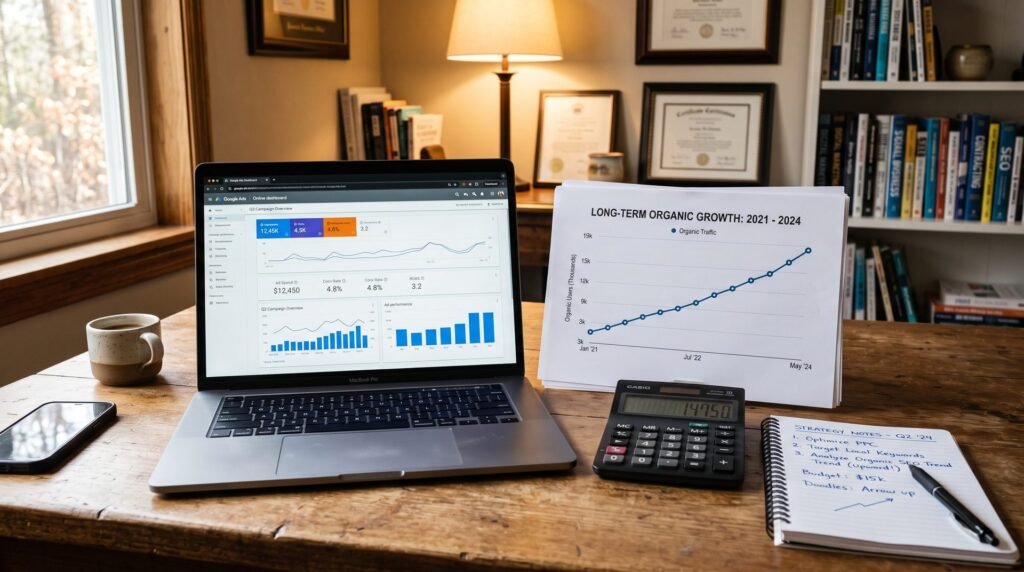
Every contractor in Albuquerque eventually faces the same budget question: should I pay Google for Local Services Ads, or invest in SEO? Both put you in front of people searching “plumber near me” — but they work in completely different ways, cost money in completely different ways, and fail in completely different ways.
This is not a “good vs. bad” article — both channels book jobs. The right answer depends on your cash flow, your timeline, and how much control you want over your own marketing. Here is the honest comparison.
In this article:
- What Local Services Ads are (and how they really work)
- What SEO is (and what it honestly takes)
- Head-to-head comparison table: cost, speed, control, lead quality
- The real cost math for contractors
- When to choose LSA, when to choose SEO, and when to run both
- What this means specifically for Albuquerque contractors
- FAQs
What Are Local Services Ads?
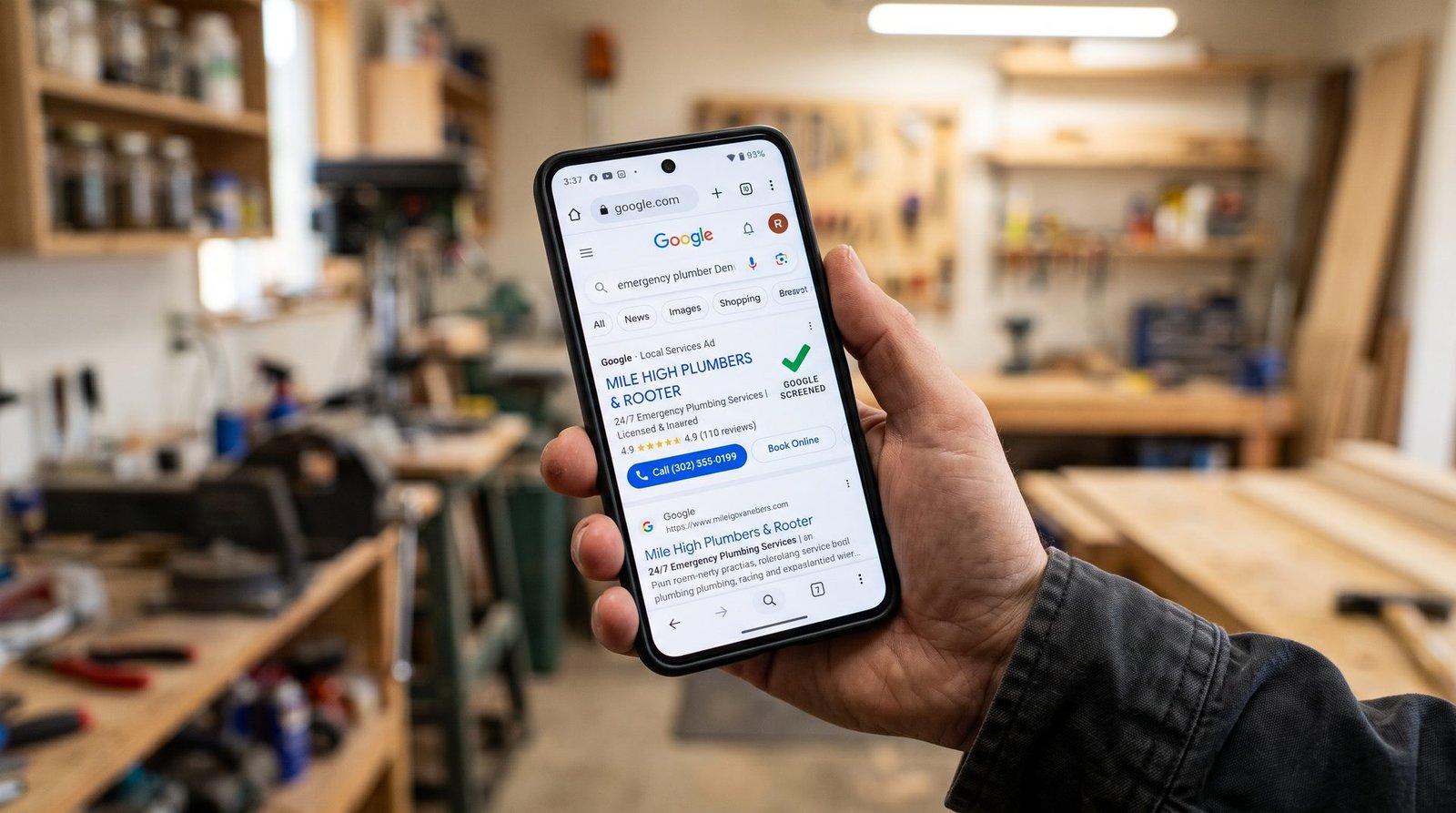
Local Services Ads (LSAs) are the row of business cards that appears at the very top of Google search results for service queries — above standard ads and above organic results. Each card shows the business name, photo, star rating, review count, years in business, a phone number to tap, and a Google trust badge. For a searcher, tapping that card is a one-step path to calling you.
The mechanics, per Google’s own documentation (Google, 2026):
- Pay per lead, not per click. You are charged only when a customer contacts you directly through the ad — a phone call, a text, or a booking. Clicks that bounce cost you nothing.
- You do not even need a website. LSA runs off your Google Business Profile and a verification process; leads arrive as phone calls and messages you manage in the Local Services app.
- Verification is mandatory. Google checks your business license, insurance, and runs background checks before your ads can run. This is what earns the badge.
- The badge has changed. In October 2025, Google replaced the older Screened/Guaranteed/License Verified badges with a single Google Verified badge (LeadSync, 2026).
- Responsiveness affects your ranking. Google notes that ad ranking is affected by how reliably you answer calls — miss too many, and your ads show less often (Google, 2026). Since your LSA listing pulls from your Google Business Profile optimization, profile completeness matters too.
- No contracts. There is no minimum spend and you can pause anytime. You set a weekly budget and control your service areas and job types.
What Is SEO (and What Does It Honestly Take)?
SEO — search engine optimization — is the work of earning top positions in the unpaid organic results and the Google map pack: your website, your Google Business Profile, your reviews, your local citations, and your content, all working together so Google ranks you for the searches that book jobs.
The honest trade-off, per Semrush’s own guidance: SEO usually takes three to six months to show meaningful results, and newer websites take longer because they have less authority and less content (Semrush, 2026). Google itself has told SEOs to expect 4 to 12 months before seeing an effect on competitive terms.
What you get for that patience is an asset: once you rank, the leads keep coming without a per-lead fee, and the results compound over time. What you must accept is that SEO is a monthly discipline — content, reviews, technical maintenance, local relevance — not a one-time purchase. For a clear picture of what real SEO work looks like month to month, see our breakdown of the work that actually has to happen every month.
Local Services Ads vs SEO: The Head-to-Head Comparison
| Factor | Local Services Ads | SEO |
|---|---|---|
| Cost model | Pay per lead — charged only when someone calls, texts, or books through the ad (Google, 2026) | Fixed monthly investment (or time) — no per-lead fee; cost per lead falls as rankings compound |
| Speed to leads | Days to weeks (once verification clears) — leads can start almost immediately | 3–6 months to meaningful results; 4–12 months in competitive markets (Semrush, 2026) |
| Control | Limited — Google matches searchers to your profile automatically; you control budget, areas, and job types, but not the ad creative or the algorithm | High — you own the website, the content, the pages, and the strategy; rankings are earned, not rented |
| Lead quality | High intent by design — callers chose your card and called; but you pay for every qualified lead including price shoppers, and lead volume depends on local competition | High intent and self-selected — callers read your reviews, your site, and chose you; quality improves as your reputation assets grow |
| Best for | New businesses needing calls now; seasonal pushes; filling an open schedule; contractors with no website yet | Established businesses playing the long game; contractors who want leads without a per-lead tax; anyone building a sellable brand asset |
The Real Cost Math for Contractors
LSA cost per lead varies widely by trade and market. Reported market ranges (Monsoft Solutions, 2026):
- Plumbing: roughly $18–$45 per lead
- Electrical: roughly $20–$50 per lead
- HVAC: roughly $25–$60 per lead
- Pest control: roughly $15–$35 per lead
- Roofing: roughly $25–$75 per lead
- General law: roughly $35–$100 per lead
Competitive metros run higher; smaller markets like Albuquerque typically sit toward the lower end of these bands. Google credits leads it judges invalid automatically, and you can dispute questionable leads within 30 days (Monsoft Solutions, 2026).
Run your own math: at ~$40 per LSA lead against a $500 average job, one booking in twelve breaks even. But notice the catch — the per-lead price never goes away. You are renting position at the top of Google forever.
SEO’s math runs the other direction. You pay a monthly investment for months with little to show — then rankings arrive and your cost per lead drops month after month, because the website and reviews you built keep producing. The crossover point usually lands in months 6–12 for competitive trades, sooner in thinner markets.
When to Choose Local Services Ads
- You need calls this month. New business, slow season, or an open install calendar — LSA is the fastest legitimate route to the phone ringing.
- You have no website (yet). Google explicitly says LSA works for businesses with no website at all (Google, 2026). It is a valid on-ramp while your site and SEO are being built.
- You can handle the phones. Remember: missed calls hurt your LSA ranking. If nobody answers reliably, you are paying for leads you then lose twice.
- Your market is not saturated. In cities with few verified competitors, LSA cost per lead stays low and placement is easy. Check your category before assuming.
When to Choose SEO
- You are tired of renting. Every LSA lead has a toll. SEO builds an asset — rankings, reviews, content — that keeps producing after the monthly spend stops growing.
- You want the customers who research. 97% of consumers read reviews before choosing a local business (BrightLocal, 2026). Those researchers land on organic results and websites, compare, and call the winner. SEO owns that journey.
- You plan to be here in two years. The compounding curve rewards patience. Contractors who start SEO today are the ones competitors complain about in 2028.
- You want control. Google can change LSA pricing, eligibility, or your ad ranking any quarter. Your website and your reviews are yours.
The Answer Most Contractors Actually Need: Both — in Sequence
The LSA-vs-SEO debate is usually framed as either/or, but the contractors who win in Albuquerque do both — in the right order:
- Months 1–3: LSA for cash flow. Get verified, set a tight service area, answer every call, and dispute invalid leads. This funds the business while SEO builds.
- Months 1–6: SEO for the asset. Build the website, fix the Google Business Profile, start the review engine, and publish service-area pages. (This is where Local SEO Albuquerque work does its compounding.)
- Month 6+: rebalance. As organic and map-pack calls grow, trim LSA spend to fill gaps — slow weeks, new service lines, new neighborhoods — instead of funding your entire pipeline with it.
Free 10-Minute Website Audit
Not sure whether your money should go to LSA or SEO? We will audit your site and local presence — rankings, reviews, call conversion, speed — and tell you honestly which channel pays back first for your trade and your market.
👉 free 10-minute website audit — Claim your free audit
📞 Prefer to talk? Call +1 505-539-3288
What Albuquerque Contractors Should Know Specifically
- LSA eligibility is category-limited. It covers common contractor trades (plumbing, HVAC, electrical, roofing, and similar) but not every niche — confirm your trade is eligible before budgeting.
- Verification takes real time. License checks and background checks mean LSA is not “live today” — plan for the verification window.
- The Albuquerque market is thinner than Phoenix or Denver. Fewer verified competitors usually means lower cost per lead and easier placement — an advantage worth using while it lasts.
- Your Google Business Profile feeds both channels. LSA pulls its listing data from your profile, and SEO’s map-pack rankings depend on it. Optimizing it once pays you twice.
- Bilingual and neighborhood targeting matter. Service-area pages for the North Valley, Rio Rancho, the South Valley, and the East Mountains catch the long-tail searches LSA’s broad matching can miss.
Local Services Ads vs SEO: The Bottom Line
LSA is renting a prime storefront on Google’s busiest street — instant traffic, monthly rent, landlord’s rules. SEO is buying the building — slow to close, yours forever, equity that compounds. Smart Albuquerque contractors rent while they buy.
🚀 Free 10-Minute Website Audit — LSA, SEO, or Both?
We will look at your rankings, reviews, call conversion, and market — then give you a straight answer on where your next dollar should go, with a prioritized fix list.
👉 free 10-minute website audit — Get your free audit
📞 Call +1 505-539-3288 — Talk strategy with a real human.
FAQs: Local Services Ads vs SEO
Is Google Local Services Ads worth it for contractors?
Often, yes — especially if you need leads fast. You pay only when someone contacts you (Google, 2026), typical home-service leads run roughly $15–$75 depending on trade and market (Monsoft Solutions, 2026), and the Google Verified badge adds trust before the phone rings. The catch is that the per-lead cost never ends and you have limited control over placement.
How much do Local Services Ads cost per lead?
It varies by trade and city: roughly $18–$45 for plumbing, $25–$60 for HVAC, and $25–$75 for roofing, with competitive metros higher and smaller markets like Albuquerque typically lower (Monsoft Solutions, 2026). Google credits invalid leads automatically and you can dispute questionable ones within 30 days.
How long does SEO take to work for a contractor?
Expect three to six months before meaningful results, longer for new websites and competitive trades (Semrush, 2026). Google itself has advised SEOs to allow 4 to 12 months for competitive terms. It is a compounding asset, not an instant channel.
Can I run Local Services Ads without a website?
Yes. Google explicitly states you do not need a website to use LSA — leads arrive as calls and messages managed in the Local Services app (Google, 2026). That said, pairing LSA with a strong website and reviews raises close rates, because researchers still check you out before calling.
Do I need reviews for Local Services Ads?
Effectively, yes. Your star rating and review count display directly on your LSA card, and Google factors responsiveness and profile quality into ad ranking (Google, 2026). Since 97% of consumers read reviews before choosing a local business (BrightLocal, 2026), weak reviews sink both LSA and SEO performance.
Should I do both LSA and SEO?
For most Albuquerque contractors, yes — in sequence. Run LSA for immediate cash flow while building SEO for months 1–6, then rebalance: let organic and map-pack rankings carry the base load and use LSA to fill gaps. Our free 10-minute website audit will tell you which channel pays back first for your specific trade — or call +1 505-539-3288.