
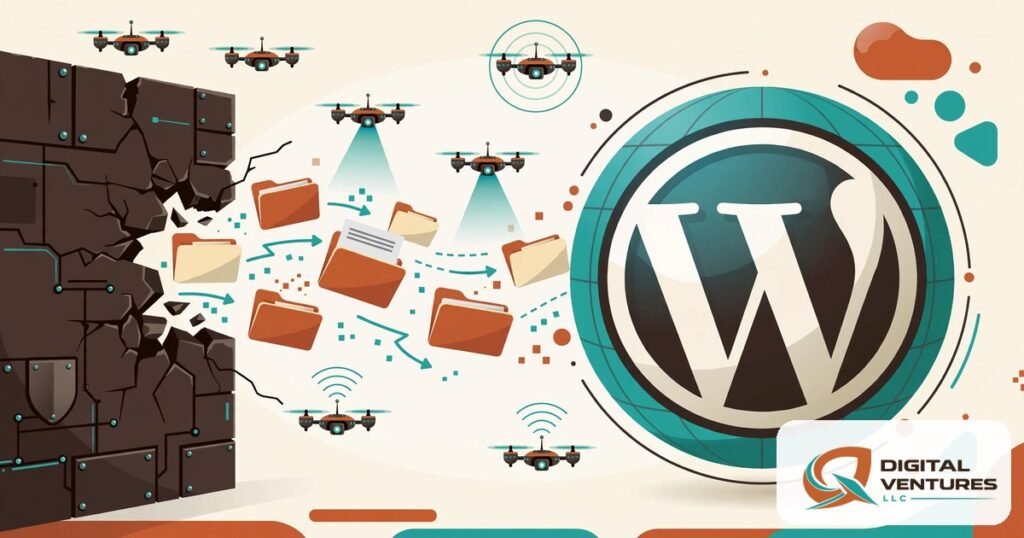
CVE-2026-87902: Remote File Inclusion in WordPress Core Is Being Exploited in the Wild
A vulnerability in a plugin is a problem for that plugin’s users. A vulnerability in WordPress Core is a problem for the web. On October 17, 2026, a technical analysis brought fresh attention to CVE-2026-87902, a remote file inclusion flaw in WordPress Core that the vendor alert rates as high severity and — critically — reports as actively exploited in the wild, with patches available. When the vendor says a core flaw is being exploited and patches exist, the only remaining question is whether your site is running the patched release.
This article explains CVE-2026-87902 in plain English: what remote file inclusion means, why WordPress’s scale turns a core flaw into a numbers game attackers always win eventually, what the honest limits of the public data are, and the five best proven ways to respond.
What Happened: Inside the Remote File Inclusion Flaw (CVE-2026-87902)
Remote file inclusion, explained simply
Remote file inclusion (RFI) is a vulnerability category in which an application can be induced to include — to load and process — content from a location the operator did not intend. Web applications routinely include files: templates, libraries, configuration fragments. When the path to an included file can be influenced by an attacker, and the application fetches that path from a remote location, the attacker can supply their own content for the application to process.
The practical impact of this remote file inclusion flaw depends on how the included content is processed — whether it is executed as code, rendered as markup, or merely read — and the vendor advisory is the authoritative place to confirm the mechanism rather than inferring it from the category name. What the public analysis establishes is the classification (remote file inclusion in WordPress Core), the severity (high), the exploitation status (reported as exploited in the wild by the vendor alert), and the remediation posture (patches available, apply promptly).
The scale changes the maths
The most striking part of the CVE-2026-87902 story is not the flaw itself but the population it affects. Public asset measurement through ZoomEye, queried on October 1, 2026, reports 7,982,191 assets matching a WordPress fingerprint — nearly eight million publicly reachable installations identifiable by observable characteristics.
That figure needs its honest caveats, and the analysis states them plainly: it describes reachable installations identified by fingerprinting, not confirmed vulnerable instances. It includes sites that are already patched, sites that are centrally managed, and sites hosted on platforms that apply updates on the operator’s behalf. It is an exposure count, not a victim count.
But the scale is still the point. At nearly eight million reachable installations, a WordPress Core flaw reaches a population large enough for automated exploitation to find targets without any targeting at all. Attackers do not need to choose victims; they scan the internet, and vulnerable sites answer. As the analysis puts it: WordPress is not uniquely fragile — it is simply everywhere, and its plugin and theme ecosystem adds tiers of code that core updates do not touch.
The honest limit
Two things the public data does not establish, and intellectual honesty requires saying so: exposure counts describe what can be seen from outside, and the exploitation status in the vendor alert describes what the vendor has observed. Neither proves that a specific site was targeted. What both establish, together, is sufficient reason to treat a core update as an emergency change rather than part of a monthly maintenance window — because at this population size, the scanning starts immediately after disclosure and does not stop.
Why core flaws are different from plugin flaws
A plugin vulnerability affects the plugin’s install base. this remote file inclusion flaw affects WordPress Core, which means it potentially affects every WordPress site on a vulnerable branch — the entire platform, not a subset. Core flaws also get the fastest attacker attention, because exploit developers know the target population is maximal. And core is the layer site owners are least able to work around: you cannot simply deactivate core the way you can deactivate a plugin. The patch is the only fix, which makes patch latency the entire security posture.
Who Is Affected by This Remote File Inclusion Flaw (CVE-2026-87902)
What is established: CVE-2026-87902 is a remote file inclusion flaw in WordPress Core, rated high severity, reported by the vendor alert as exploited in the wild, with patches available. The affected version ranges and the fixed releases are defined in the project’s own advisory — consult it for the exact branches, and update to the patched release for your branch.
The population at risk: The ZoomEye measurement of 7,982,191 WordPress-fingerprinted assets (October 1, 2026) frames the exposure. Every unpatched site on an affected branch is a potential target of automated scanning.
How to check: In your WordPress dashboard, confirm your exact version under Dashboard → Updates, then compare it against the fixed releases in the vendor advisory. If automatic background updates are enabled, verify they completed — do not assume.
Why CVE-2026-87902 Matters
1. “Exploited in the wild” is the highest urgency signal
Vendor alerts use careful language, and “exploited in the wild” is among the strongest phrases in it. It means the vendor has observed real attacks, not just theoretical ones. For this remote file inclusion flaw, that status converts the flaw from a patch-soon item into a patch-now emergency. Every hour unpatched is an hour in which automated scanners — which began the moment the flaw became public — may reach your site.
2. Scale defeats obscurity
“Security through obscurity” was never real security, but small sites sometimes benefit from attackers’ economics: scanning everyone costs effort, and tiny sites are not worth targeted attention. This remote file inclusion flaw defeats that comfort completely. At eight million reachable targets, attackers do not need to care about your site specifically; the scan finds you as a matter of arithmetic. No WordPress site is too small to be scanned.
3. A core patch does not clean the rest of the installation
This is the critical follow-through that the analysis emphasizes: updating core closes the remote file inclusion hole, but it does not remove anything an attacker already installed. Modified core files, unexpected administrator accounts, injected scripts in the database, and rogue scheduled tasks all survive the update. If your site was exposed during the window between disclosure and patching, the update is step one of incident response, not the whole of it.
4. The ecosystem multiplies the surface
Core is the foundation, but the average WordPress site runs a stack of plugins and themes — each its own code, its own vulnerabilities, its own update cadence. The analysis notes that the plugin and theme ecosystem adds tiers of code that core updates do not touch. A site fully patched against this remote file inclusion flaw can still fall to any of the plugin flaws disclosed this same week. Core patching and plugin patching are both required; neither substitutes for the other.
5. Patch latency is the only variable you control
Strip the remote file inclusion story to its essentials and one fact remains: you cannot control when flaws are found, how many sites are exposed, or how fast scanners move. The only variable in your hands is the time between a patch becoming available and that patch running on your site. Everything else in this article — the severity rating, the wild exploitation, the eight-million-site exposure count — is context for a single decision: how many hours will your site stay vulnerable after the fix exists? Sites with automatic background updates or managed maintenance answer in hours. Sites updated “when someone gets around to it” answer in weeks. This remote file inclusion flaw rewards the first group and punishes the second, and the mechanism of that punishment is fully automated.
What to Do Now: 5 Best Proven Ways to Respond to CVE-2026-87902
Way 1: Update WordPress Core to the patched release immediately
Treat this as an emergency change, not a monthly-window item. Go to Dashboard → Updates, install the patched release for your branch as identified in the vendor advisory, and confirm the running version afterward. If automatic background updates are enabled, verify they actually completed. At this remote file inclusion flaw’s scale, the scanning started immediately — your patching should too.
Way 2: Hunt for persistence that survives the update
Because this remote file inclusion flaw is reported as exploited in the wild, assume exposure during the pre-patch window is possible. Check for the classic persistence indicators: modified core files (compare against a fresh download of your version), unexpected administrator accounts under Users → All Users, injected scripts in posts, widgets, or the database, and scheduled tasks (WP-Cron entries) you did not create. A core patch without a persistence hunt can leave the attacker in place.
Way 3: Determine whether remote inclusion paths exist on your site
Review whether your site can include remote resources through any configuration or plugin path, and disable that capability where it is not required. Server-side controls that block outbound requests from the web tier provide a useful backstop against remote file inclusion attacks generally — not just CVE-2026-87902. Fewer ways for the application to fetch remote content means fewer ways for an inclusion flaw to matter.
Way 4: Apply the same review to plugins and themes
A core patch does not clean the rest of the installation. Update every plugin and theme to its latest release — this week alone brought critical disclosures in LearnPress, LatePoint, and WP Booking System alongside the core news — and remove anything you no longer use. Deactivated-but-installed plugins are still code on your server; delete what you do not need.
Way 5: Track versions per site, not per fleet
If you operate many sites, track the WordPress version per site rather than per fleet, because the vulnerable unit is the individual installation. A fleet dashboard that says “mostly updated” hides the three sites that are not. With this remote file inclusion flaw, each unpatched installation is independently scannable and independently exploitable — per-site verification is the only verification that counts.
FAQ: CVE-2026-87902
Q: What is CVE-2026-87902?
A: CVE-2026-87902 is a remote file inclusion vulnerability in WordPress Core, rated high severity. The vendor alert reports it as actively exploited in the wild, with patches available. It was the subject of a technical analysis published October 17, 2026.
Q: Is CVE-2026-87902 being exploited right now?
A: According to the vendor alert, yes — it is reported as exploited in the wild. Independent confirmation of specific victims is not public, but at WordPress’s scale (nearly 8 million reachable installations per ZoomEye’s October 2026 measurement), automated exploitation of a public core flaw should be assumed.
Q: How do I know if my site is affected by CVE-2026-87902?
A: Check your exact WordPress version under Dashboard → Updates and compare it against the affected ranges and fixed releases in the project’s advisory. Then update to the patched release for your branch and verify the update completed.
Q: I updated core. Is my site clean?
A: The update closes CVE-2026-87902, but persistence mechanisms — rogue admin accounts, modified files, injected database content, malicious scheduled tasks — survive updates. Hunt for those indicators as described above, especially if your site was unpatched while the flaw was public and reportedly exploited.
Conclusion
This remote file inclusion flaw is the purest illustration of the WordPress security equation: a core flaw plus eight million reachable sites plus automated scanning equals an emergency for everyone, regardless of size or obscurity. The vendor has done its part — patches exist, and the alert is unambiguous about active exploitation. The remaining variable is patch latency on individual sites, and that variable is entirely in site owners’ hands. Update core now, hunt for persistence, lock down remote-inclusion paths, patch the plugins too, and verify per site. At this scale, there is no such thing as a site too small to patch today.
Keeping every site patched, scanned, and verified — core, plugins, themes, per-site — is a full-time discipline. Qamar Digital Ventures LLC‘s website care plans make it automatic: prompt updates, continuous monitoring, and real backups, across your whole fleet. Visit https://qamardigitalventuresllc.com/ and take patch latency off your worry list for good.
Sources
- dev.to, “CVE-2026-87902: Remote File Inclusion in WordPress Core, and the Scale Behind It” (Oct 17, 2026) — https://dev.to/bianliang/cve-2026-87902-remote-file-inclusion-in-wordpress-core-and-the-scale-behind-it-4781
- Tenable CVE watch listing for CVE-2026-87902 — https://www.tenable.com/cve
- ZoomEye asset measurement, WordPress product fingerprint counts (collected October 1, 2026) — https://www.zoomeye.ai/