
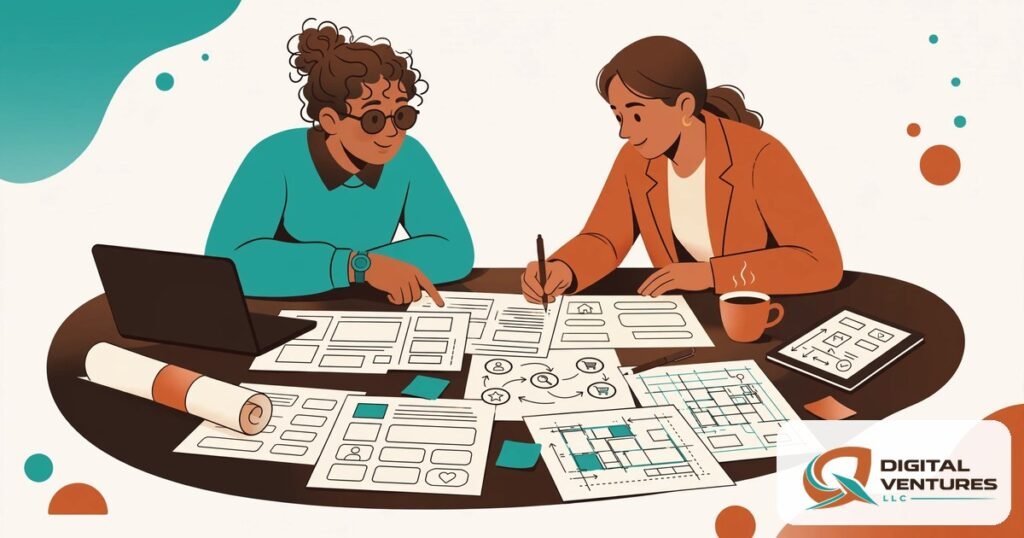
The Web Design Discovery Process: How Good Projects Start
Every troubled website project has the same origin story. Someone got excited about a new look, skipped the planning, jumped straight into design — and six weeks later the homepage is beautiful, the messaging is wrong, the pages nobody visits are finished, and the pages that would actually generate leads were never discussed. The web design discovery process exists to prevent exactly this. It is the structured work that happens before a single pixel is placed: understanding your business, your customers, your content, and your goals, so the design that follows has something solid to stand on.
Discovery is not paperwork for its own sake. Industry practitioners describe it the same way across the board: skipping the strategy phase is like building a house without blueprints — it might look nice, but behind the walls there is chaos (hollerdigital.com). Blend Interactive puts it even more plainly: the better you plan for a site, the more efficient and cost-effective that site build ends up; measure twice, cut once (blendinteractive.com). This article walks through what the web design discovery process actually involves, why it matters more than the design itself, and what a good one looks like from the client’s side of the table.
What the Web Design Discovery Process Actually Is
The web design discovery process is the research and strategy phase that opens every well-run web project. Before wireframes, before color palettes, before a single line of code, the project team works to answer three deceptively simple questions: who will visit this site, what do they need from their visit, and what does the business need the visit to accomplish (blendinteractive.com). Everything else — sitemaps, content plans, technical requirements, timelines, budgets — flows from those answers.
A proper web design discovery process typically includes stakeholder interviews, audience and persona definition, user journey mapping, a content audit of the existing site, competitive and contemporary analysis, technical requirements gathering, performance benchmarks, accessibility planning, and an SEO readiness review (hollerdigital.com; blendinteractive.com). None of this is glamorous. All of it is load-bearing. The design phase that follows is dramatically faster and cheaper when discovery has already resolved the hard questions — what the site must say, to whom, and in what order.
Think of it this way: design answers “how does it look,” development answers “how does it work,” but the web design discovery process answers “what are we building and why.” Projects that skip the third question almost always end up redesigning the first two.
Why Skipping Discovery Is the Most Expensive Mistake in Web Design
Clients sometimes ask to skip discovery to save time or money. It feels efficient. It is the opposite. Here is what a web design discovery process protects you from, compared with what happens without one:
| Risk | Without a web design discovery process | With a web design discovery process |
|---|---|---|
| Scope creep | Features get invented mid-project; budget balloons | Scope defined up front; changes are conscious decisions |
| Wrong messaging | Copy written around design, not customers | Messaging built from audience research first |
| Missing pages | Key conversion pages discovered after launch | Full sitemap agreed before design begins |
| Rework | Weeks of design discarded when strategy shifts | Strategy locked before design hours are spent |
| Timeline slips | “Two more weeks” becomes two more months | Realistic timeline based on defined deliverables |
| SEO damage | Relaunch tanks rankings nobody measured | Baseline audited; redirects and structure planned |
| Stakeholder conflict | Disagreements surface at final review | Alignment built during interviews, not at launch |
The pattern is consistent: the web design discovery process does not add cost to a project — it moves cost from the expensive end (rework, delays, relaunch repairs) to the cheap end (thinking and planning). Framework Design’s process documentation makes the same point: every project begins with discovery so the work is built on a clear strategic foundation rather than assumptions (frameworkdesign.ie). Assumptions are the most expensive material in web design because you pay for them twice — once when they are built, once when they are rebuilt.
There is also a quieter benefit. Discovery is where a project team proves it understands your business before you have committed to the full build. If the questions are shallow, the proposal is vague, and the “strategy” is a mood board, you have learned something valuable about the vendor — cheaply, and early. That alone makes the web design discovery process worth doing.
The Web Design Discovery Process at Qamar Digital Ventures
Process descriptions are easy to write and easy to fake, so here is what ours concretely involves — the actual sequence a project moves through, and what you receive at each step. We are a registered New Mexico LLC based in Albuquerque, and for more than a decade we have built WordPress websites for US service businesses. That focus shapes our web design discovery process: it is practical, plain-spoken, and aimed at one outcome — a website that brings you customers.
If you want the longer version of who we are and how we got here, read our story. The short version is that we have seen what happens when projects skip the planning phase, and we refuse to build that way.
Step 1: The Stakeholder Conversation
Every web design discovery process starts with a conversation, not a questionnaire. We talk through your business: what you sell, who buys it, what a good month looks like, what frustrates you about the current site, and what success would actually change for you. Swan Creative describes the same starting point — a discovery session of direct questions about services, audience, purpose, and aspirations before anything else is proposed (swancreative.co.uk).
The goal is not to collect facts; it is to find the gaps between what you think the site should do and what your customers actually need. Those gaps are where projects fail. A 45–60 minute conversation, done well, surfaces more useful direction than a 50-question form ever will.
Step 2: Audience and Customer Definition
Next we define — precisely — who the site is for. Not “homeowners,” but the specific people who hire your kind of business: what problem woke them up at 2 a.m., what they searched, what worried them about hiring someone, and what would make them choose you over the next result. Blend Interactive’s web design discovery process formalizes this as audience definition, personas, and stakeholder or user interviews (blendinteractive.com).
This step quietly determines the entire site. The audience definition decides the messaging hierarchy, the page structure, the offers, and the calls to action. A site built for “everyone” converts no one; the web design discovery process forces the specificity that design alone cannot supply.
Step 3: Content and Site Audit
If you have an existing site, we audit it before proposing anything new: which pages get traffic, which convert, which are dead weight, what content can be kept, what must be rewritten, and what is missing entirely. The Digital Culture Network’s process guide treats this as a formal stage — logging current content, assessing effectiveness, and deciding keep, amend, or remove for every page (digitalculturenetwork.org.uk). Holler Digital adds heatmap and analytics review plus technical SEO groundwork to the same phase (hollerdigital.com).
This is also where SEO reality gets established. Rankings, indexed pages, backlinks, and current search visibility are measured before the redesign so nothing valuable is accidentally destroyed. A surprising number of redesigns lose half their organic traffic because nobody wrote down what was working before the rebuild. Our web design discovery process treats the existing site as an asset to inventory, not a embarrassment to delete.
Step 4: Sitemap and Information Architecture
With audience and content understood, we map the site: every page, its purpose, its place in the hierarchy, and the journey a visitor takes from landing to contact. This is the blueprint the house analogy keeps pointing to. Rugby Web Design’s process puts it well — the message and structure get found before the website gets designed, because a site works best when its message is clear (rugbywebdesign.co.uk).
The deliverable is a sitemap you can actually read and approve — not a technical diagram, but a plain map of “here is every page, here is what each one does, here is how visitors flow through.” Approving the structure before design begins is one of the highest-leverage moments in the entire web design discovery process. Moving boxes on a sitemap costs nothing; moving sections on a finished design costs days.
Step 5: Technical Requirements and Constraints
Now the practical engineering questions: what must the site integrate with (booking systems, CRMs, payment processors, email platforms), what are the performance targets, what are the accessibility requirements, and what does the content management need to look like for your team day to day? Framework Design lists integrations, features, content structure, and timelines as the concrete outputs of this scoping work (frameworkdesign.ie).
This step also covers the unglamorous decisions that determine whether you enjoy owning the site: hosting, backups, security, update responsibility, and who fixes what when something breaks. A web design discovery process that skips technical planning hands you a beautiful site with a maintenance time bomb inside. We would rather have the boring conversation now than the emergency call later.
Step 6: Success Metrics and Measurement Plan
A website without defined success metrics is a project that can never be declared successful — or held accountable. Before design begins, we agree on what winning looks like in numbers: form submissions, phone calls, quote requests, booked consultations, or whatever the business actually runs on. Then we plan the tracking that will measure it: conversion events, call tracking, and the dashboards that report them.
This is the step most vendors skip and most clients never think to ask about. It is also the step that separates a website from a lead generation system. The web design discovery process earns its keep here by forcing the question early: how will we know this worked? If nobody can answer that before the build, nobody will be able to answer it after.
Step 7: The Proposal You Can Actually Evaluate
Discovery ends with a proposal grounded in everything above — not a template with your logo pasted in, but a scope that references your audience, your sitemap, your integrations, and your metrics. Swan Creative’s process follows the same logic: the discovery session produces a proposal detailing all aspects of the project as discussed, and only then do timelines get built (swancreative.co.uk). Because the scope came from research rather than guesswork, the timeline and budget in that proposal are commitments, not aspirations.
Here is the complete web design discovery process in one view:
| Step | What happens | What you receive |
|---|---|---|
| 1. Stakeholder conversation | 45–60 min working session on goals, frustrations, and success | Shared understanding of the real objectives |
| 2. Audience definition | Customer research, personas, buying triggers | Documented audience profiles |
| 3. Content and site audit | Traffic, conversion, and SEO inventory of the current site | Keep/amend/remove content plan |
| 4. Sitemap and architecture | Full page map and visitor journeys | Approved sitemap |
| 5. Technical requirements | Integrations, performance, accessibility, maintenance | Technical specification |
| 6. Success metrics | Agreed KPIs and tracking plan | Measurement plan |
| 7. Proposal | Scope, timeline, and budget from the research | A proposal you can evaluate |
How Long Does the Web Design Discovery Process Take?
Shorter than you fear, and the time pays for itself. For a typical small-business website, our web design discovery process runs one to two weeks from first conversation to approved proposal — most of that is our research and documentation time, not meetings on your calendar. Your actual time investment is usually two to three hours total: the stakeholder conversation, a review of the audience and sitemap drafts, and the proposal walkthrough.
Larger projects — e-commerce, membership, multi-location — can take three to four weeks of discovery. The principle scales: the more complex the build, the more expensive assumptions become, and the more discovery is worth. What does not scale is skipping it. A two-week planning phase on an eight-week build is the cheapest insurance in the project.
Questions a Good Web Design Discovery Process Asks You
If you are evaluating vendors, the questions they ask in the first meeting tell you everything about their web design discovery process. A serious one will ask some version of these — drawn from the discovery sessions practitioners actually run (swancreative.co.uk; digitalculturenetwork.org.uk):
- What does your business do, in the words your customers would use?
- Who is your best customer, and what problem were they trying to solve?
- What is the primary purpose of the website — what should a visitor do?
- What frustrates you most about your current site?
- Which pages or content must be kept, and what is missing?
- What systems must the site connect to (booking, CRM, payments, email)?
- Who will update the site day to day, and how technical are they?
- How will we measure whether this project succeeded?
If a vendor’s entire discovery is “what colors do you like and can you send your logo,” you have your answer about how the project will go. Design taste is easy to find. The web design discovery process is what separates a decorator from a partner.
What Happens After Discovery
Discovery is the beginning, not the project. Once the sitemap, requirements, and metrics are approved, the familiar phases follow — wireframes, visual design, content, development, testing, launch — each one faster and calmer because the decisions were made upstream. The Digital Culture Network’s guide lays out the same downstream flow: create (sitemap, wireframes, visuals, build), then curate (content population, testing, refinements, launch) (digitalculturenetwork.org.uk).
The difference discovery makes shows up in those later phases as absence: absent arguments about page structure, absent “we forgot the booking integration,” absent redesigns of finished work, absent launch-day SEO disasters. Clients often tell us the project felt “easy.” It felt easy because the hard part happened in weeks one and two, on paper, where changes are free. That is the whole point of the web design discovery process — and it is why we will not start a project without one.
Frequently Asked Questions
What is the web design discovery process in simple terms?
It is the planning phase before design begins: researching your business, your customers, and your goals, then turning that research into a sitemap, technical requirements, and success metrics. Think of it as the architectural blueprint before construction. Without it, designers guess; with it, they execute a plan everyone already approved.
Do small businesses really need a web design discovery process?
Yes — arguably more than large ones, because small businesses can least afford rework. Discovery for a small-business site is not a six-week consulting engagement; it is a focused one-to-two-week process with a few hours of your time. The cost of skipping it (wrong messaging, missing pages, blown timelines) hits small budgets hardest.
How is discovery different from just getting a quote?
A quote prices a guess; discovery prices a plan. When a vendor quotes without discovery, they are estimating undefined work — which is why such projects so often run over budget. A web design discovery process defines the work first, so the proposal that follows is based on your actual sitemap, integrations, and requirements rather than assumptions.
What should I prepare before a discovery session?
Less than you think. Know your business goals, have access to your current website analytics if they exist, and be ready to talk honestly about what is and is not working. A good web design discovery process does the heavy lifting — the research, the audit, the documentation. Your job is candor; ours is everything else.
Can discovery be done remotely?
Absolutely. The stakeholder conversation, reviews, and approvals all work over video call and shared documents. Being in Albuquerque, we work this way with clients across the US routinely — the web design discovery process loses nothing over Zoom that it had in person, as long as the questions are the right ones.
Conclusion
Good website projects do not start with design. They start with the web design discovery process — the disciplined work of understanding your business, your customers, and your goals before anyone opens a design tool. It is what prevents scope creep, wrong messaging, missing pages, and the quiet catastrophe of a beautiful site that generates nothing. One to two weeks of planning, a few hours of your time, and a proposal grounded in research instead of guesswork: that is how good projects start, and it is the only way we build.
Book a real consultation — request a free SEO or website audit, and we will walk through what a discovery process would uncover for your business specifically. Or book a consultation directly — either way, the first conversation is where good projects start, and it costs you nothing.
Internal Link Suggestions
- Money page: free SEO or website audit → /free-website-seo-audit/ (readers ready to start the discovery conversation)
- Sibling guide 1: 9 Web Designer Red Flags Before You Sign → /book-a-call/ is the consultation page; red-flags guide pairs with vendor evaluation theme
- Sibling guide 2: WordPress for Your Business Website: The Practical Case → pairs with our WordPress-focused build approach
- About page: our story → /about/ (brand trust for conversion readers)
Sources
- https://hollerdigital.com/insights/website-design/why-having-a-plan-is-essential-the-importance-of-project-discovery/
- https://www.blendinteractive.com/services/discovery-research/
- https://swancreative.co.uk/what-is-our-web-design-process/
- https://www.frameworkdesign.ie/how-we-work
- https://digitalculturenetwork.org.uk/knowledge/simple-guide-to-website-design-process/
- https://www.rugbywebdesign.co.uk/process