
Every website owner eventually needs something changed: a new service added, a price updated, a photograph replaced, a page rewritten, a button that stopped working. The question is never whether changes will be needed — it is what happens when you ask for one. This article describes what happens when you ask for a website change at Qamar Digital Ventures: the request journey, step by step, in plain English. There is no jargon hidden in the description, no invented client story, and no claim that every change is instant. A change is useful only when it is understood, made correctly, checked, and recorded — and that is the standard this article is written to.
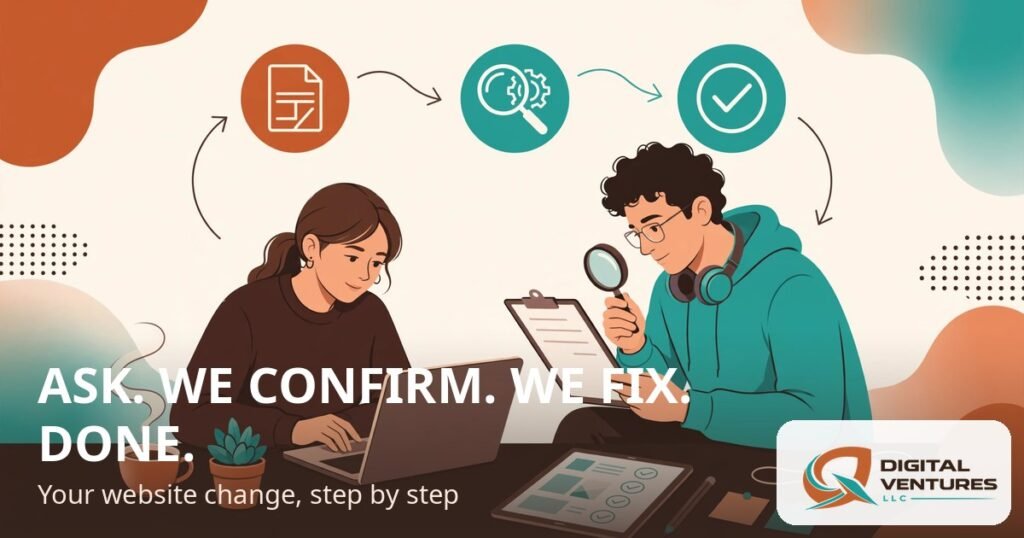
The short answer to what happens when you ask for a website change is that it follows a clear path: you tell us what you need, we confirm what we understood, we make the change, we check it, and we tell you it is done. Most changes take hours or days, not weeks, and the ones that take longer are the ones worth discussing first. The rest of this article walks that path in detail, so you know before you ask: what to send us, what we will ask back, how long each kind of change takes, and what happens if something goes wrong.
What Happens When You Ask for a Website Change at a Glance
| Step | What happens | What you get |
|---|---|---|
| You ask | Send the change in your own words | An acknowledgement the same day |
| We confirm | We repeat back what we understood | A written summary before any work starts |
| We make it | The change is made on your website | The change, made once, made properly |
| We check it | Tested on desktop and phone | A check that it works, not just that it was made |
| We tell you | A plain-English note when it is live | Confirmation, and a record of what changed |
Step 1: You Ask — In Your Own Words
The first step in what happens when you ask for a website change is the simplest: tell us what you need, in your own words. There is no form to fill in, no technical language required, and no wrong way to ask. “Please add our new service to the services page.” “The price on the pricing page is out of date — it should be this.” “The contact form is not sending me emails.” Each of those is a complete request, and each one starts the same process. If you can send a screenshot, a link to the page, or the new text or photograph, that helps — but it is not required to start.
What matters most at this step is the outcome you want, not the method. You do not need to tell us which plugin to use or which file to edit; that is our work. You need to tell us what should be different when the change is done, and why it matters to your business. A request that says “make the phone number bigger on mobile” is clear. A request that says “make the site better” is a conversation, not a change, and we will treat it as one: we will ask what “better” means to you, and turn it into a list of specific changes before anything is done. What happens when you ask for a website change starts with understanding, and understanding starts with your words.
Step 2: We Confirm — Before Any Work Starts
The second step in what happens when you ask for a website change is confirmation, and it is the step that prevents most mistakes. Before any work starts, we repeat back what we understood: the page, the change, and the result you should expect. If the request is clear, the confirmation is short — a sentence or two, and we start. If the request is ambiguous, the confirmation is a question: “Do you mean the price on the pricing page, or the price mentioned on the home page?” “Should the new service appear above or below the existing ones?” These questions take minutes and save hours, because a change made to the wrong page, or in the wrong way, has to be undone before it can be done right.
Confirmation also covers the practical questions: how long the change should take, whether it affects anything else on the site, and whether it needs anything from you — new text, a photograph, a decision. If a change is bigger than it first appeared — if updating one price means updating three pages, or if adding a service means rethinking a whole section — we will say so before starting, with the honest time and scope, so you can decide with the facts in front of you. What happens when you ask for a website change includes this pause, deliberately, because a change made in a hurry is a change made twice.
Step 3: We Make It — Once, Properly
The third step in what happens when you ask for a website change is the work itself, and our rule for it is simple: make it once, make it properly. A text change is made in the page, not pasted over it. A photograph is uploaded at the right size, not stretched to fit. A new service is added with the same structure as the existing ones, so the page stays consistent. A fix is made at the cause, not at the symptom — if the contact form is not sending emails, we find why, rather than adding a second form beside the broken one.
Small changes — text updates, photograph swaps, price corrections, link fixes — are usually done the same day or the next. Larger changes — a new page, a rewritten section, a new feature — take longer, and we will give you a realistic timeframe at the confirmation step rather than a hopeful one. What happens when you ask for a website change is not a race; it is a sequence, and the sequence matters more than the speed. A change made carefully the first time is cheaper, faster, and safer than a change made quickly and repaired later, and that is the calculation we make on your behalf every time.
What Happens When You Ask for a Website Change: The Ones That Take Longer
Some changes take longer, and it is worth knowing which ones before you ask. A new page takes longer than a text edit, because it needs structure, copy, photographs, and checks. A change to the design — colours, layout, the header — takes longer than a content change, because it affects every page, not one. A change that needs something from a third party — a payment provider, a booking system, a domain setting — takes as long as that third party takes, and we will tell you that plainly rather than pretending otherwise. What happens when you ask for a website change of this kind is a short conversation first: what it involves, how long it should take, and what we need from you to start. The conversation is part of the service, not a delay in it.
Step 4: We Check It — On Desktop and Phone
The fourth step in what happens when you ask for a website change is the check, and it is the step most often skipped elsewhere. Before we tell you a change is done, we test it: on a desktop and on a phone, on the page it belongs to and on the pages it might affect. A text change is read back for errors. A photograph is checked for size and placement. A link is clicked. A form is submitted. A new service is checked against the navigation and the search results it should appear in. The check takes minutes, and it catches the mistakes that would otherwise be discovered by your customers.
We also check that the change did not break anything else. A website is a connected thing: changing a heading can change a search result, changing a photograph can slow a page, changing a link can strand a visitor. What happens when you ask for a website change in our practice includes checking the connections, not just the change itself, because a change that fixes one thing and breaks another is not a finished change. If the check finds a problem, we fix it before telling you the work is done — not after.
Step 5: We Tell You — And We Record It
The fifth step in what happens when you ask for a website change is the simplest and the most important: we tell you it is done, in plain English, with a link to the page so you can see it yourself. No jargon, no ticket number, no “deployed to production” — a short note that says what changed, where it is, and what to look at. If the change was bigger than expected, the note says what else was affected. If the change needs anything from you next — a review, a decision, a photograph — the note says that too.
We also record the change. Every change we make is documented — what was changed, when, and why — so that the next change starts from a known state instead of a mystery. That record is yours: it belongs to your website, and it travels with it, whether we are still working together in a year or not. What happens when you ask for a website change ends with a website whose history is written down, and a history that is written down is a website that can be maintained, improved, and handed over without guesswork. That is the quiet benefit of the whole process, and the one that pays off longest.
What Happens When You Ask for a Website Change: Small, Medium, and Large
| Size | Examples | Typical time | What to expect |
|---|---|---|---|
| Small | Text update, photo swap, price fix, link fix | Same day or next day | Quick confirmation, quick check, done |
| Medium | New section, rewritten page, new service | A few days | Confirmation, draft, check, then live |
| Large | New page, new feature, design change | A week or more | Conversation first, then a plan, then the work |
The table is a guide, not a promise: every change is judged on its own facts, and the confirmation step is where the real timeframe is set. But the pattern holds — what happens when you ask for a website change depends on the size of the change, and the process scales with it rather than breaking. A small change gets a small process; a large change gets a conversation and a plan. Neither gets lost, neither gets forgotten, and neither gets made without being checked.
What Happens When You Ask for a Website Change: If Something Goes Wrong
Sometimes a change does not work as expected. A photograph uploads at the wrong size, a link points to the wrong page, a form stops sending emails after an update. What happens when you ask for a website change and something goes wrong is the real test of the process, and our answer is straightforward: we fix it, we tell you what happened, and we record it so it does not happen again. A website change that goes wrong is not a failure of the relationship; it is a normal part of maintaining a website, and the measure of the work is how quickly and honestly it is put right.
The safety net behind that answer is the record and the checks. Because every change is documented, a problem can be traced to its cause instead of guessed at. Because every change is checked before it is declared done, most problems are caught before you ever see them. And because the website’s history is written down, a problem that appears months later can be traced back to the change that caused it, rather than treated as a mystery. What happens when you ask for a website change includes this safety net, whether you ever need it or not, because a process that only works when nothing goes wrong is not a process at all.
What Happens When You Ask for a Website Change for a New Mexico Business
The process for what happens when you ask for a website change does not change for a New Mexico business, but the detail does. A change for an Albuquerque business might mean updating hours for a seasonal rush, adding a service area, or replacing photographs after a completed job across town. A change for a Santa Fe business might mean updating holiday hours before the tourist season. A change for a Las Cruces or Rio Rancho business might mean adding a town to the service area, or updating a service page with local detail. The request journey is the same — ask, confirm, make, check, tell — and the local detail is carried through it, not added at the end.
Local-intent searches such as “web design Albuquerque” and “SEO services New Mexico” show the same pattern in a different trade: customers comparing providers by town, in plain language. A business whose website changes are handled the way this article describes — understood first, made once, checked, and recorded — will have a website that keeps up with its business, and a website that keeps up is a website that keeps earning. What happens when you ask for a website change at Qamar Digital Ventures is designed for exactly that: a website that grows with the business it serves, one understood change at a time.
Frequently Asked Questions About What Happens When You Ask for a Website Change
How long does it take when you ask for a website change?
Small changes — text updates, photograph swaps, price corrections, link fixes — are usually done the same day or the next. Medium changes take a few days, and large changes take a week or more. What happens when you ask for a website change is that we confirm the scope first and give you a realistic timeframe before starting, rather than a hopeful one.
Do I need to use technical language when I ask for a website change?
No. Tell us what you need in your own words, and send a screenshot, a link, or the new text or photograph if you have them. What happens when you ask for a website change starts with understanding, and understanding starts with your words — the technical part is our work, not yours.
Will I be told when the change is done?
Yes. Every change ends with a plain-English note, with a link to the page so you can see it yourself. What happens when you ask for a website change includes that confirmation as a required step, not an optional one — a change is not finished until you have been told it is done and can check it yourself.
What if the change I ask for turns out to be bigger than expected?
We will tell you before starting, with the honest time and scope, so you can decide with the facts in front of you. What happens when you ask for a website change of this kind is a short conversation first: what it involves, how long it should take, and what we need from you to start. The conversation is part of the service, not a delay in it.
What happens when you ask for a website change and something goes wrong?
We fix it, we tell you what happened, and we record it so it does not happen again. Because every change is documented and checked before it is declared done, most problems are caught before you ever see them, and a problem that appears later can be traced to its cause. What happens when you ask for a website change includes this safety net, whether you ever need it or not.
Conclusion
Asking for a website change should feel easy, and it should be. The journey for what happens when you ask for a website change is five steps — you ask in your own words, we confirm what we understood, we make it once and properly, we check it on desktop and phone, and we tell you it is done and record it — and each step exists to prevent a specific kind of mistake. The confirmation prevents the wrong change. The careful making prevents the quick fix that needs repairing. The check prevents the error your customers would find. The record prevents the mystery next time. Together they add up to a website that keeps up with its business, one understood change at a time.
If your website needs a change — a price, a photograph, a page, a fix — the first step is the easiest one: tell us what you need, in your own words. To start, explore our SEO services cost in Albuquerque, request a free website audit, or book a call to talk through what you need. Book a real consultation — request a free SEO or website audit.