A new website should not be built for the business you have today alone. It should be built for the business you intend to become, without making you pay today for features you do not yet need. That balance, start small and scale later, is the heart of how we plan a website that grows with you at Qamar Digital Ventures LLC, an Albuquerque, New Mexico based company with more than 10 years of WordPress experience serving US service businesses. This article explains how we plan a website that grows with you in practice: the structure we set up on day one, the choices we deliberately leave open, and the growth moments we plan for so that expansion feels additive, not disruptive.
Most small business websites hit a wall after the initial build, and the reason is rarely a lack of ambition. It is that the navigation, service pages, and URLs were not designed to expand, so every new offering becomes a patch job that costs more and converts less. A site built as a brochure, with a flat list of pages and no system underneath, can look fine at launch and become painful within a year, as soon as the business adds a service, opens in a new town, or launches a campaign. How we plan a website that grows with you is designed to prevent that wall, by treating the site as a system from the beginning, even when the first version is small.
How We Plan a Website That Grows With You: Structure Before Design
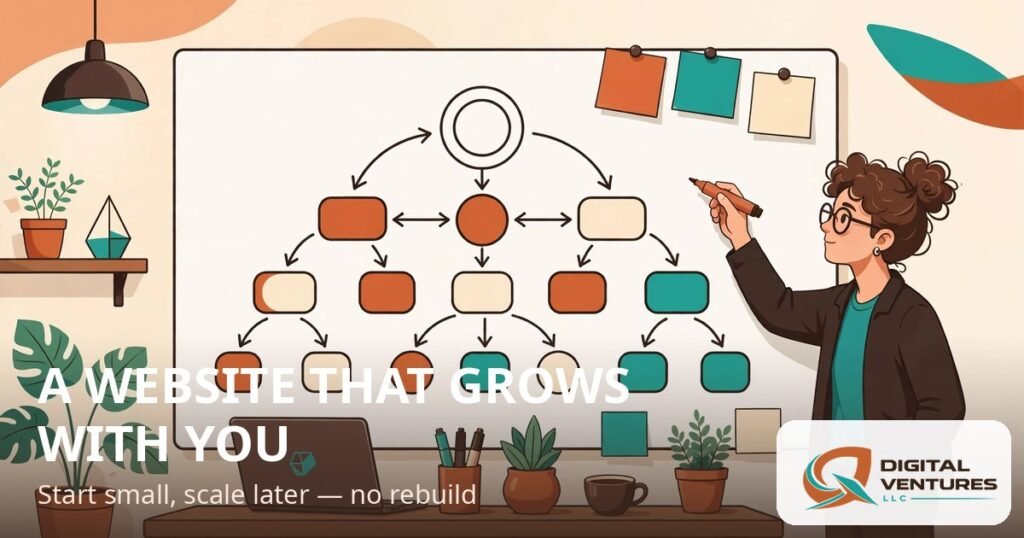
The most important growth decision is made before any visual design begins, and it is about structure: how services are grouped, named, and connected. This is how we plan a website that grows with you at the foundation level. We organize services into families that can hold child pages over time. A family page, sometimes called a pillar page, gives the overview and builds trust. Child pages cover specific services, locations, or campaigns, and they can be added one at a time without rearranging the whole site. When a business later adds five new offerings, they slot into families that already exist, instead of appearing as stray pages nobody can find.
That structure also includes rules for internal linking, agreed before the site grows. Every child service page links back to its family page. Family pages link to all of their children and stay updated as children are added. Related services link to two to four adjacent services, not to a huge list. These rules sound small, but they are how we plan a website that grows with you in a way that stays understandable to visitors and to search engines. When the linking rules stay consistent, each new page does more than rank on its own: it reinforces the whole site, strengthens topical relevance, and makes it easier for search engines to trust the next service or location page.
Start With the Services You Have, Leave Room for the Rest
A common mistake is building navigation for only the services that exist today, hard-coded in a way that breaks when a fourth or fifth service arrives. How we plan a website that grows with you avoids that trap by designing navigation that can expand gracefully: a services menu built around families, not a fixed list, and page templates that can be reused for new services without redesigning anything. If you currently offer three core services but plan to add more, the site should already know where the fourth and fifth will live. That foresight costs little at the start and saves a great deal later.
How We Plan a Website That Grows With You: Platform, Hosting, and Templates
Three practical choices determine whether a site can grow without a rebuild, and how we plan a website that grows with you addresses all three explicitly, rather than leaving them to chance.
An Open, Extensible Platform
We build on WordPress, because it is open and extensible: new pages, features, and integrations can be added without starting from scratch, and the business owns its content and data. Closed, all-in-one builders may feel easier at first, but they often restrict integrations, code access, and export options, which turns growth into a migration project. How we plan a website that grows with you favors platforms that support custom code, widely supported tools, and full ownership, because growth should never require permission from a platform to continue.
Hosting That Can Grow With Traffic
Shared hosting may be sufficient for a new site, but it lacks the performance and stability needed for sustained growth. As traffic increases, a site needs hosting that can scale: virtual private servers with dedicated resources, or cloud hosting that draws on multiple servers as demand increases, often supported by a content delivery network that caches content closer to visitors. How we plan a website that grows with you includes an honest conversation about hosting at the start: what the current plan handles comfortably, what the signs of outgrowing it look like, and what the upgrade path is, so a traffic spike becomes a good problem rather than an outage.
Templates and Components, Not One-Off Pages
A scalable site is built from reusable components: sections that can be reused, rearranged, and updated independently. A service page template, a location page template, and a landing page framework mean that adding a new page is a matter of filling in content, not commissioning a new design. How we plan a website that grows with you relies on these templates, because they keep new pages consistent with the rest of the site, reduce the time each addition takes, and prevent the slow drift into ten different page styles that makes a growing site look patched together.
| Growth need | Without a plan | How we plan a website that grows with you |
|---|---|---|
| New service | Stray page, menu rework, broken structure | Child page inside an existing family, linked by rule |
| New town or area | Duplicated thin page, unclear navigation | Location template with genuine local content |
| New campaign | One-off page, disconnected from the site | Landing page framework tied to services and tracking |
| More traffic | Slowdowns, hosting surprise | Upgrade path agreed in advance, CDN ready |
| New feature or integration | Platform limits force a migration | Open platform, widely supported tools |
| More content | Inconsistent styles, lost hierarchy | Content hierarchy decided before volume grows |
How We Plan a Website That Grows With You: Content Hierarchy and SEO for the Long Term
Growth in content needs a map, not just enthusiasm. How we plan a website that grows with you includes a content hierarchy: a clear statement of what content exists, how important each piece is, and how people are expected to move through it. Broad family pages target broader intent, such as a service category, while child pages and landing pages capture specific searches that increase as the business specializes. Deciding what a new page is trying to rank for before writing it prevents the common problem of five pages competing for the same search, and it keeps the site’s growth compounding rather than cannibalizing itself.
That hierarchy also protects search visibility during growth. A scalable site keeps its URL patterns consistent, its navigation intuitive, and its internal links purposeful, so new pages strengthen the pages around them. When a business adds a location, a service, or a campaign, the new page should arrive with its links, its place in the hierarchy, and its measurement already decided. How we plan a website that grows with you treats that discipline as part of the build, not as an afterthought to be fixed during a later audit.
Design That Stays Timeless While the Business Changes
A design that chases trends will look dated just as the business starts to grow, tempting an expensive redesign at exactly the wrong moment. How we plan a website that grows with you favors a clean, timeless layout with consistent branding: colors, typography, and logo placement that look polished for years, and modular sections that can be refreshed individually rather than all at once. Growth then means updating a section or adding a page, not rebuilding the visual identity every time the business adds a service.
How We Plan a Website That Grows With You: The Growth Moments We Plan For
It helps to name the moments when a website is most likely to strain, because how we plan a website that grows with you is really a plan for those moments, made while they are still hypothetical and cheap to prepare for.
The first moment is the new service. A business that adds a service needs a page, a menu entry, and links from related pages, all without disturbing existing rankings. The second moment is the new location, which needs a genuinely useful local page, not a copy of another town’s page with the name changed. The third moment is the campaign, which needs a landing page that matches the advertisement or offer and can be measured separately. The fourth moment is the traffic spike, from a seasonal rush, a referral, or a piece of content that takes off, which needs hosting and caching that absorb the load. The fifth moment is the integration, such as a booking system, a customer relationship tool, or a payment gateway, which needs a platform that welcomes connections rather than resisting them.
Planning for these moments does not mean building them all on day one. That would waste money and delay launch. How we plan a website that grows with you means building the structure, templates, and upgrade paths that make each moment a small project instead of a crisis. Start small, in other words, but start with a system that knows how to grow.
How We Plan a Website That Grows With You: What We Deliberately Do Not Build Yet
Honesty about growth also means saying what not to build yet, and how we plan a website that grows with you includes that discipline. Features that serve a future business size, such as complex multi-location systems for a single-location business, or advanced automation for a team of one, are noted and deferred, not built speculatively. Building them early costs money, adds complexity that slows the site, and often guesses wrong about what the business will actually need. A growth plan that says “not yet” clearly is more trustworthy than one that builds everything at once and calls it future-proof.
That restraint is also a form of respect for the owner’s budget. A small business website should launch quickly, start earning enquiries, and then grow from revenue, not from a large upfront bet on features. How we plan a website that grows with you keeps the first version focused on the pages and actions that earn business now, with the expansion paths documented so that growth, when it comes, is a decision rather than a rescue.
Frequently Asked Questions About How We Plan a Website That Grows With You
What does it mean for a website to grow with my business?
It means the site can add services, locations, campaigns, content, and features over time without a rebuild, a migration, or a loss of search visibility. How we plan a website that grows with you achieves this through service families, reusable templates, consistent linking rules, an open platform, and a hosting upgrade path, so each addition strengthens the site rather than patching it.
Should I pay for growth features before I need them?
Usually not. How we plan a website that grows with you starts small and scales later: the structure and templates for growth are set up on day one, but features for a larger future business are deferred until they are actually needed. That keeps the launch fast and affordable, and it avoids paying for guesses about a future that may arrive differently than expected.
Will my website need a redesign when my business doubles?
Not necessarily, if it was planned for growth. A site built with expandable service families, modular templates, and a timeless design can often absorb a doubling of services or content through new pages and section updates, rather than a full redesign. A redesign becomes necessary when the underlying structure cannot expand, which is exactly what how we plan a website that grows with you is designed to prevent.
How does a growing website stay fast and easy to navigate?
By keeping the same disciplines that made the small site fast: properly sized images, lean code, a navigation that expands by families rather than by endless lists, and a content hierarchy that gives every new page a clear place. How we plan a website that grows with you also includes a hosting upgrade path and caching, so traffic growth does not turn into slowdowns. Regular reviews, as the site grows, catch drift before it becomes a problem.
What should I ask a web designer about growth before hiring?
Ask how new services and locations will be added, what templates will be reused, whether you own your content and data, what the hosting upgrade path is, and what a typical addition costs after launch. The answers reveal whether growth was planned or merely promised. How we plan a website that grows with you should be explainable in plain language before you sign, because a growth plan you cannot understand is not a plan you can rely on.
Conclusion
A website that grows with your business is not a bigger website. It is a better-organized one: service families that welcome new children, templates that make new pages consistent, links that follow rules, a platform that stays open, and hosting that can step up when traffic does. That is how we plan a website that grows with you, starting small, launching fast, and scaling later, one deliberate addition at a time, without rebuilds, migrations, or lost momentum. If your current site already feels like it is straining at its edges, that strain is information, not failure, and a review can show which parts of the system need attention before the next stage of growth.
If you would like a website planned this way, or a review of whether your current site can grow, explore our WordPress development services, request a free website audit, or book a call to talk through your plans. Book a real consultation — request a free SEO or website audit.