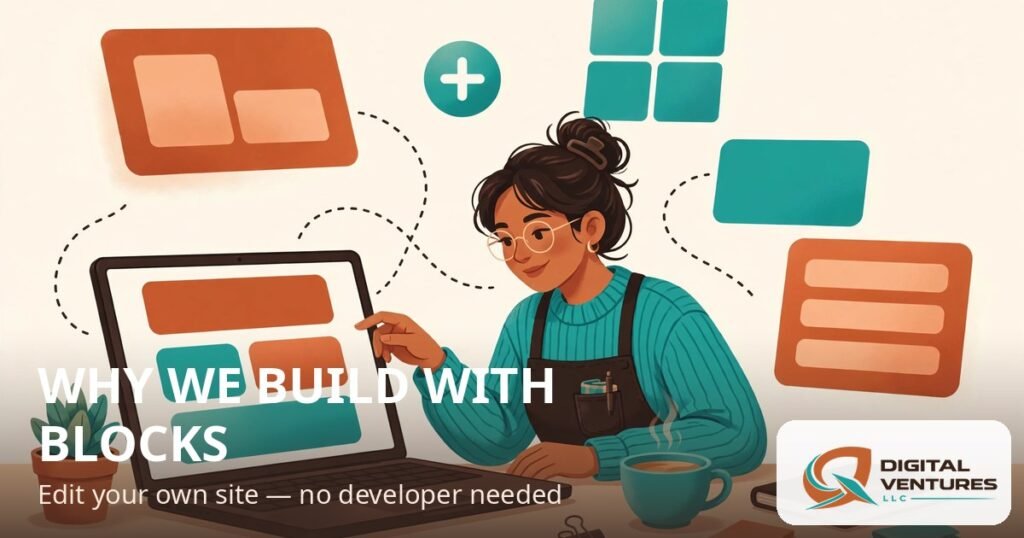
Every website is built with some system for arranging its pages, and that system decides who can change the site later. A site built with a heavy third-party builder can look impressive on launch day and become a burden the first time you want to change a headline without calling a developer. A site built with the system that comes inside WordPress itself stays editable, stays portable, and stays understandable. That is why we build websites with wordpress blocks, and this article explains the reasoning in plain English.
The block editor is the editing system built into WordPress itself. Content is made of blocks: a paragraph is a block, an image is a block, a heading, a button, a gallery, a set of columns. You move blocks, edit blocks, and delete blocks, all in the same place where you write. There is no separate builder to learn, no extra layer between you and your content, and no dependency on a single vendor’s plugin to keep your pages working. When we say that is why we build websites with wordpress blocks, we mean it as a decision about your next five years with the site, not just about launch week. That long-term view is exactly why we build websites with wordpress blocks.
Reason 1: You Can Edit Your Own Website
The first reason why we build websites with wordpress blocks is the simplest: you can edit your own website without a developer for everyday changes. Change a service description, swap a photo, update your hours, add a new testimonial, publish a post. Each of those is a block operation, and each takes minutes once someone shows you where things live. That is the difference between a website you use and a website you rent attention for: when editing is easy, the site stays current, and when editing is hard, the site quietly goes stale.
We show every client how to edit their own site before handover, and we document where things are, because a site you cannot edit is a site you do not own in any practical sense. That is why we build websites with wordpress blocks rather than with systems that require specialist knowledge for routine changes. The block editor meets you where you are: if you can write a document, you can edit a block-based page, and the skills you learn writing a post transfer directly to editing a service page or a landing page. This editability is the everyday proof of why we build websites with wordpress blocks.
Reason 2: Real Ownership, Not Rented Pages
Ownership is the second reason why we build websites with wordpress blocks, and it is the one clients thank us for years later. Pages built with the editor that ships inside WordPress are stored as standard WordPress content. If you ever change providers, redesign, or move hosts, your content moves with you in a form any WordPress professional can work with. Pages built inside a proprietary builder, by contrast, often depend on that builder’s code to display at all, which means leaving the builder can mean rebuilding the pages.
This is not a theoretical concern. We have all seen businesses discover, at redesign time, that their pages were effectively rented from a plugin, and that the redesign quote included rebuilding everything from scratch. That is why we build websites with wordpress blocks: your pages should belong to you in a durable, portable form, not to the tool that happened to build them. Ownership also means your content survives plugin changes, vendor changes, and fashion changes in web design tools, because it rests on the platform itself rather than on an add-on.
What Ownership Looks Like in Practice
| Situation | Block-based site | Builder-dependent site |
|---|---|---|
| Change providers | New provider edits your existing pages directly | New provider may need to rebuild pages first |
| Redesign in three years | Content reused, new design applied around it | Content often trapped in old builder layouts |
| Plugin discontinued | Pages keep working; editor is part of WordPress core | Pages may break or lose their layout |
| Owner edits a headline | Minutes, no developer needed | Often possible, but inside the builder’s system |
| Site speed over time | Leaner output, fewer layers of code | Extra code from the builder layer on every page |
Reason 3: Fewer Moving Parts, Fewer Surprises
Every plugin added to a site is a dependency: something that needs updates, can conflict with something else, and can be abandoned by its maker. The block editor is part of WordPress core, which means it is updated together with WordPress, documented in the official handbook, and maintained by the same project that maintains the platform. That is why we build websites with wordpress blocks: fewer moving parts means fewer surprises, fewer conflicts, and fewer emergency fixes caused by a builder update changing how pages render.
This is also a performance argument. Third-party builders add layers of code to every page, and that code has to load before visitors see anything. Block-based pages produce leaner output, which helps pages load faster, and fast pages help both visitors and search engines. Nobody hires us for performance alone, but every client benefits from a site that is not carrying weight it does not need, and that is one more reason why we build websites with wordpress blocks instead of reaching for the heaviest tool first. Simplicity is a feature, and it is another reason why we build websites with wordpress blocks.
Reason 4: Consistency Without Rigidity
A common worry about building with blocks is that sites will all look the same. In practice, the opposite problem is more common: sites where every page was designed separately, so nothing matches and every new page requires a designer. Blocks solve this with patterns: prepared layouts for common sections, such as a services grid, a testimonial row, a pricing table, or a call-to-action band, that editors can insert and adapt. Patterns give a small business consistency without rigidity, because the layout is prepared but the content is yours to change.
That is why we build websites with wordpress blocks for small businesses in particular. A service business does not need a unique work of art on every page; it needs pages that look like they belong to the same business, that a staff member can update without breaking the design, and that can grow by adding sections rather than by redesigning. Patterns deliver that, and they do it inside the same editor the owner already knows, instead of inside a second system with its own rules. Consistency without a second system to learn is a quiet advantage, and part of why we build websites with wordpress blocks.
Reason 5: A Future That Moves With WordPress
WordPress itself is moving toward blocks everywhere, not just in posts and pages. The same block interface now designs headers, footers, and templates in modern block themes, which means the skills you learn editing a page transfer to editing the whole site. That direction of travel matters when choosing a building method, because a method aligned with the platform’s future gets better with every WordPress release, while a method fighting the platform’s direction accumulates friction.
That long view is the final reason why we build websites with wordpress blocks. We have worked with WordPress for more than ten years, and we have watched editing systems come and go. The systems that lasted were the ones built into the platform, documented openly, and usable by the site’s owner. Blocks fit that pattern, and they fit it for the smallest brochure site as well as for a growing service business adding pages month after month. Choosing blocks is choosing the boring, durable option, and boring and durable is exactly what a business website should be.
What Blocks Are Not: An Honest Note
Blocks are not the right answer for every conceivable design. Layouts that need pixel-level control over every section, or effects that a specialized builder offers with one click, may take more effort with blocks, sometimes requiring custom patterns or code. We say that plainly because a method chosen honestly should come with its limits stated, not hidden until launch week. For the vast majority of small business websites, though, those limits never appear: service pages, location pages, posts, galleries, forms, testimonials, and calls to action are all natural block content, and they are the pages a service business actually needs.
If your project genuinely needs something blocks handle poorly, we will tell you that too, and we will quote the custom work honestly rather than forcing blocks where they do not fit. That honesty is part of why we build websites with wordpress blocks as our default: a default chosen for good reasons, with exceptions made openly, is more trustworthy than a tool pushed for every job regardless of fit. Those limits do not change why we build websites with wordpress blocks as our default.
How We Build With Blocks: Our Approach
Our block-based builds follow a simple pattern. We start with a modern block theme, so colors, fonts, headers, and footers are controlled in one place without extra plugins. We design a small set of reusable patterns for the sections your business actually uses, so new pages stay consistent. We build your core pages from those patterns, with real content, not placeholder text. Then we hand the site over with a walkthrough and documentation, so you can edit confidently from day one. That is why we build websites with wordpress blocks in this structured way: the system is only as good as the patterns and documentation around it, and we treat both as part of the build, not as extras. That structure is the practical expression of why we build websites with wordpress blocks.
We are a registered New Mexico LLC based in Albuquerque, working primarily with US service businesses, and our builds reflect that audience: clear service pages, honest local detail for the towns actually served, and pages designed to turn visitors into enquiries. Blocks support that goal directly, because a page that is easy to keep current is a page that keeps earning trust, while a page frozen by an editing system nobody wants to touch slowly stops representing the business at all.
Frequently Asked Questions About why we build websites with wordpress blocks
Is the block editor hard to learn?
No. If you can write and format a document, you can edit block-based pages. A paragraph is a block, an image is a block, and moving or deleting either one is a click or a drag. That ease of learning is central to why we build websites with wordpress blocks: the editor meets owners where they are, and the same skills transfer from posts to pages to whole-site templates as a business grows.
Will my site look generic if it is built with blocks?
No, unless it is built carelessly. Blocks are a construction system, not a design: the same blocks produce wildly different sites depending on the theme, patterns, colors, fonts, and content. Our patterns are designed for your business, not pulled unchanged from a catalog, so your site looks like yours. That is why we build websites with wordpress blocks rather than with page templates that stamp the same design onto every client.
What happens to my pages if I stop working with you?
Your pages keep working, because they are standard WordPress content built with the editor inside WordPress itself. Any WordPress professional can edit them, redesign around them, or move them to another host. That portability is a deliberate part of why we build websites with wordpress blocks: your website is an asset you own, not a subscription to our tooling, and leaving us should never mean rebuilding your site.
Do blocks work for larger, growing websites?
Yes. Block patterns and reusable sections scale well: new service pages, location pages, and posts follow the same consistent patterns, and the site grows by adding sections rather than by redesigning. For most service businesses, blocks remain the right system well beyond the launch site. If a project ever outgrows blocks, that is a conversation with a clear scope, not a surprise, which is one more reason why we build websites with wordpress blocks as our default.
Can I still get a custom design with blocks?
Yes. Custom design lives in the theme, the patterns, and the styling, all of which we design for your business. Blocks decide how content is structured and edited, not how beautiful the result can be. Clients sometimes assume a block-based site must look plain; the reality is that the best-looking small business sites we build are block-based, because the design effort goes into patterns and content instead of into fighting a builder’s defaults.
Conclusion
Why we build websites with wordpress blocks comes down to five practical reasons: you can edit your own site, you truly own your pages, there are fewer moving parts to break, patterns keep new pages consistent, and the system moves with WordPress itself into the future. None of those reasons is glamorous, and all of them pay off quietly, month after month, in a site that stays current, stays portable, and stays yours. That is the kind of website a small business deserves: not a showpiece that freezes on launch day, but a working tool that grows with the business.
If you would like a website built this way, or a review of whether your current site can be rebuilt on blocks, explore our SEO audit services, request a free website audit, or book a call with us. Book a real consultation — request a free SEO or website audit.